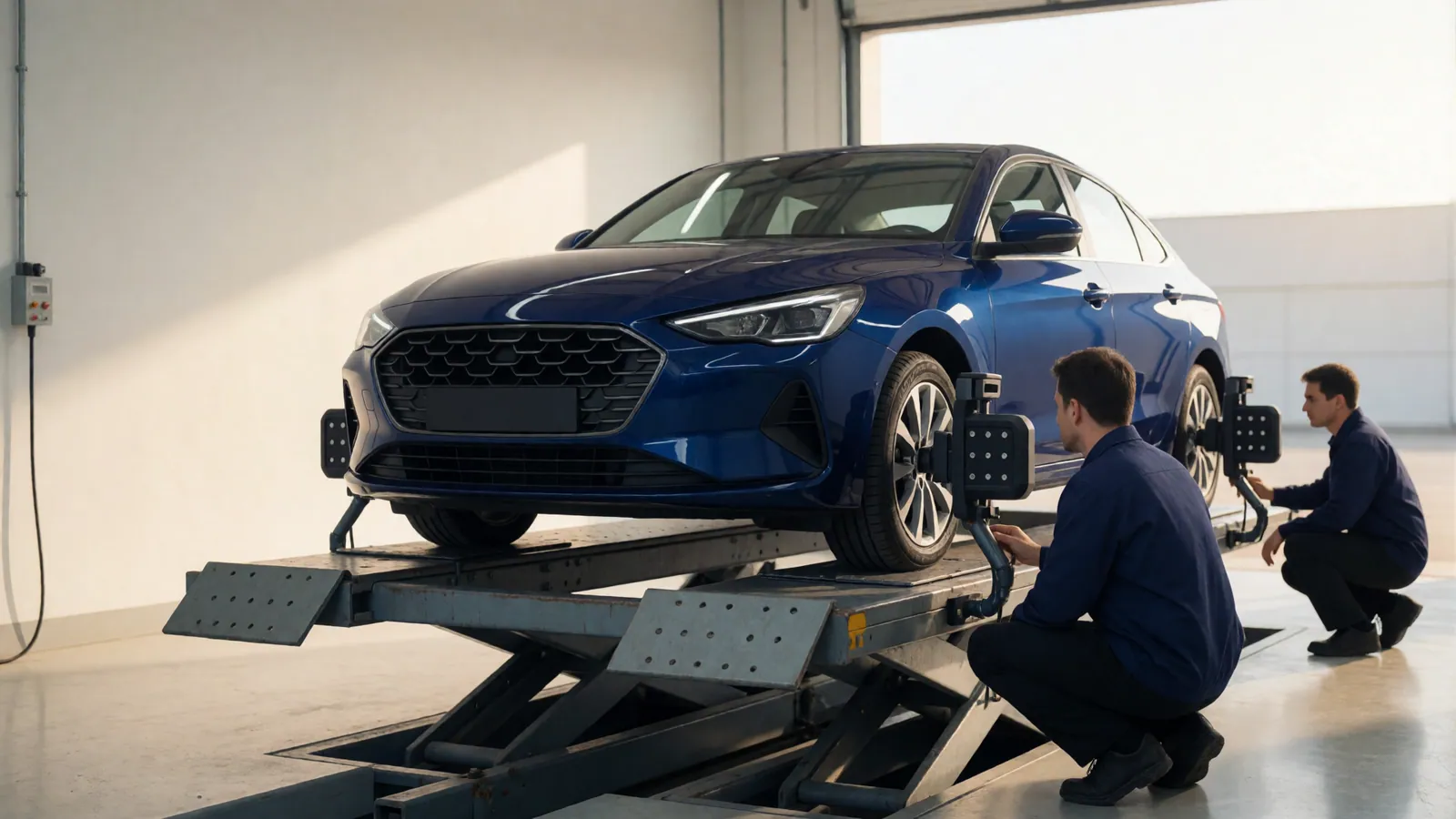
Before the list
Equipment is the honest measure of a shop
A sign, a lift and a compressor will get a shop open. Whether it can actually find an intermittent electrical fault, balance a tire that three other shops gave up on, or match a colour that has faded for five years depends entirely on what is behind that sign, and almost none of it is visible from the parking lot.
None of what follows is exotic. It is the equipment that turns a guess into a measurement, kept current and used by somebody trained on it. That combination, current equipment plus trained hands, is the actual product. Either one without the other is close to worthless.
Finding the fault
Diagnosis
Before anything is repaired, it has to be found, and finding it is where the real skill lives.
Marque diagnostic software
Kept on live subscription for the marques we see most. A generic code reader gives you a five-character fault code that describes a symptom; the manufacturer's own software gives you live data, bidirectional control, and the ability to command a component and watch whether it responds.
Lab oscilloscope
For faults that a scan tool cannot see — a sensor signal that is present but wrong, an injector that is opening slightly late, a wiring fault that only appears when the loom warms up. Slower and harder than reading codes, and the only thing that finds certain problems.
Smoke machine
Fills an intake or an evaporative system with dense inert vapour at low pressure and shows you exactly where it escapes. Finds vacuum and evaporative leaks in minutes that can otherwise absorb hours of guessing.
Refrigerant recovery and recharge station
Recovers what is in the system, weighs it, holds a vacuum to prove the system is sealed, and then charges the exact factory weight back in. A system charged 'until the gauge looks right' is a system charged wrongly.
The contact patch
Tires and alignment
The four points where your car actually touches the road, measured rather than eyeballed.
Road-force balancer
A plain spin balancer tells you the wheel is balanced when it is stationary and spinning freely. A road-force balancer presses a loaded roller against the tire and measures it under load, which is how you find the stiff spot in a tire that makes a perfectly balanced wheel shake at 60 mph. It is the single piece of equipment that solves the most 'three shops could not fix this' complaints we see.
Four-wheel alignment rack
Measures all four wheels against each other and against the manufacturer's geometry, then prints what it found before and after. Front-wheel-only alignment is a legacy of cars that no longer exist; if the rear axle is out, aligning the front just points the error somewhere else.
Touchless tire changer
Breaks the bead and levers the tire without a steel bar ever touching the rim. On an alloy wheel this is the difference between a tire change and a tire change plus a scratched rim you did not have when you arrived.
The specialist bays
Body, paint and high-voltage safety
Kept behind their own doors, for different reasons: one for dust control, one for a genuine electrical risk.
Sealed downdraft paint booth
Filtered air moving from ceiling to floor so dust travels away from the wet panel instead of settling onto it, with heated cure afterwards. The reason our paint work does not have to be polished flat to hide the dirt in it.
Spectrophotometer
Reads the colour of your actual panel and calculates the mix from that, rather than trusting the paint code on the door jamb. Sun, washing and time move a colour a long way in five years, and a code-matched panel next to a faded one is worse than not painting it.
Insulated high-voltage tooling
A separate, locked set of tools rated to 1,000 volts, plus insulating gloves that are pressure-tested on a schedule and thrown away rather than repaired. Hybrid and electric systems are genuinely dangerous and are treated that way.
The honest limit
What none of this equipment can actually do
A scan tool does not diagnose a car. It reports a fault code, which is a symptom rather than a cause, and reading it correctly is the difference between a modest repair and an expensive parts-swapping exercise that never fixes the actual problem. A road-force balancer does not decide a tire is bad. It produces a number, and somebody still has to know what that number means for your specific car.
Every piece of equipment on this page makes a good technician faster and more certain. None of it makes an untrained one competent. That is the entire argument for asking who is actually running the equipment, not only what the shop owns, and it is why we would rather you met the team than toured the tool room.
A written estimate with photographs, before any work
Book your car in
Every car that comes in goes on a lift and gets a documented inspection before anything is priced, and that inspection is free. You get photographs of what we found and a line-by-line estimate on your phone, and nothing happens until you reply.