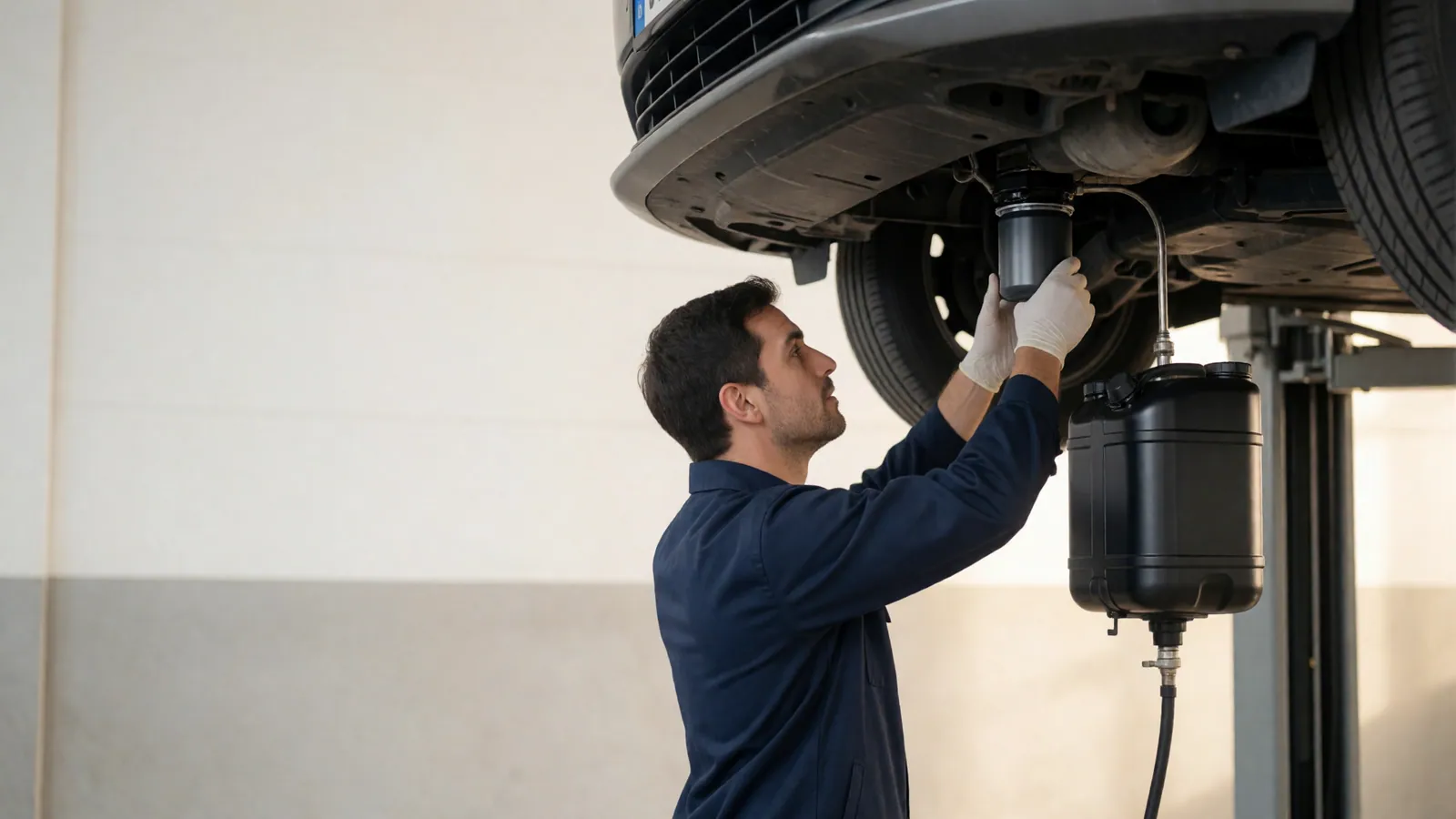
Roughly twice a year for most drivers · $89
Every 5,000 – 7,500 miles
- Full synthetic oil and filter
- Tires rotated and set to placard pressure
- Brake pads and discs measured and recorded
- All fluid levels checked and topped
- Battery and charging system tested
- Documented 30-point inspection with photographs
Roughly every 18 months · $189
Every 15,000 miles
- Everything in the 5,000-mile service
- Cabin and engine air filters replaced
- Brake fluid moisture tested
- Suspension and steering inspected on a lift
- Exhaust and underbody inspected for corrosion
- Drive belt and hoses inspected
Roughly every three years · $389
Every 30,000 miles
- Everything in the 15,000-mile service
- Brake fluid replaced
- Four-wheel alignment checked and adjusted
- Cooling system pressure tested
- Transmission fluid condition assessed
- Spark plugs inspected or replaced to the manufacturer's interval
Roughly every six years · $549
Every 60,000 miles
- Everything in the 30,000-mile service
- Coolant replaced to the manufacturer's specification
- Transmission fluid serviced
- Spark plugs replaced
- Drive belt replaced
- Suspension components assessed for wear and reported with photographs
The one that decides the next hundred thousand · From $749
Every 100,000 miles
- Everything in the 60,000-mile service
- Timing belt replaced where the engine uses one
- Water pump replaced alongside the belt, because doing it twice costs double
- Full underbody and corrosion survey with photographs
- Written ranking of what to spend money on over the next two years
Two schedules, not one
Your car's own schedule versus this table
These are the intervals we would use on a car with no manufacturer schedule to follow. Yours almost certainly has one, and where it differs from this table we follow your manufacturer rather than our table — including the long-interval oil changes some marques specify, which we will fit but will also tell you honestly what we think of. Bring the book or the plate and we will tell you exactly where your car is against its own schedule.
Where to find your car's real interval
The owner's manual, the maintenance minder or oil-life monitor on the dashboard, or the sticker inside the door jamb or under the hood from the last shop that serviced it. Bring any of them and we will read it against this table for you.
Long-interval synthetic oil claims
Some manufacturers specify 10,000 or even 15,000 miles between oil changes on paper. We will fit to that interval if you ask us to, and we will also tell you what we genuinely think of stretching an oil change that far in stop-start city driving, in writing, so the decision stays yours.
A car with no service history
If nobody can tell you what has and has not been done, we treat it as overdue on everything until the fluids and the brakes prove otherwise, and price the inspection accordingly rather than guessing kindly.
When the two schedules disagree
Your manufacturer's schedule wins. This table exists for the smaller number of cars that genuinely have nothing better to follow, and for comparing what a manufacturer interval actually costs against what it says on the sticker.
The fine print manufacturers rely on
Why Woodside traffic makes your car older than its odometer
Almost every manufacturer publishes two maintenance schedules — a normal one, and a shorter one for what they call severe service. Read the actual definition of severe service and most driving in this borough qualifies, which is why the schedule on the sticker is frequently the wrong one for the car actually being driven.
Short trips
Repeated trips under five or ten miles, especially in cold weather, mean the engine rarely reaches full operating temperature for long enough to burn off condensation and fuel dilution in the oil. A car that only does the school run and the station is a severe-service car by definition.
Stop-and-go traffic
The expressway at rush hour and the avenues at almost any hour both count. Stop-and-go loads the transmission, the brakes and the cooling system harder per mile than steady highway driving, which is exactly what the severe schedule is written for.
Extended idling
Sitting in traffic or waiting outside a school with the engine running does not accumulate mileage, so a mileage-only interval understates the wear. Hours matter as much as miles for oil life in a car that idles a great deal.
Dust, salt and extreme temperature
Road salt through the winter, and a hundred-degree day sitting in a parking lot in summer, both belong on the severe list. Queens gets a full dose of both every year.
None of this changes the schedule we quote you. It means that if your car spends its life in this kind of driving, the shorter of any two intervals your manufacturer publishes is almost certainly the honest one for your actual car, and we will tell you which one that is rather than default to the longer number.
What actually kills a car early
The four things that shorten a car's life more than anything else
Not a dramatic single failure, usually. A car that dies at 90,000 miles and a car still working at 220,000 are very often the same design, separated by four ordinary habits.
Skipped oil changes
Oil does not fail gently. It oxidises, loses its film strength and starts letting metal touch metal, and the damage is cumulative and invisible until a bearing or a cam lobe has already worn. Every mile past the interval spends down an engine's life a little faster than the mile before it.
Ignored coolant
Coolant is not just antifreeze. Its corrosion inhibitors deplete on a schedule whether or not the temperature gauge ever moves, and a cooling system running on exhausted coolant slowly eats the water pump, the radiator and the heads from the inside, right up until the day it does it suddenly instead of slowly.
Driving on worn tires
Beyond the safety cost, worn tires change how every other system on the car is loaded. A car that hydroplanes or fails to stop cleanly does damage far beyond the tire that caused it, and the wear that got it there is entirely visible beforehand to anyone who checks.
Ignoring a small leak
A small oil or coolant leak is not a small problem being patient with you. It is a large problem at an early, cheap stage, and the difference between fixing a leaking seal for two hundred dollars and replacing what it starved for two thousand is almost always just time.
Bring the book, or just the plate
We will tell you exactly where your car stands
Against its own manufacturer schedule, not a generic one — and against the severity of how it is actually driven, not how it is driven on a manufacturer's test track.